Skip to content

Types of winds and their names
Types of winds and their names: A comprehensive guide for sailors
25/06/2026
Author: Travelboat Team
Understanding the nature of the invisible force that drives a yacht is the absolute foundation of safe and satisfying sailing. Whether you're planning a family vacation in Masuria or a dynamic cruise with friends in Croatian waters, the wind often dictates the playing field. For beginner sailors, meteorology can be a challenge, while experienced skippers are constantly on the lookout for details about local squalls.
In this article, we comprehensively discuss wind types , wind directions, and wind names , decipher nautical acronyms in weather forecasts, and explain how gust direction and strength affect a vessel's behavior on the water. Discover how advanced meteorological knowledge can facilitate daily navigation aboard a yacht.
Click on the link and check out the offer for yachts in Croatia
How are winds classified? The most important directions and their symbols.
Before you set sail, you should know precisely what winds are and how professional forecasters and skippers classify them. Globally, we distinguish between constant winds (e.g., trade winds), seasonal winds (monsoons), and variable winds, which include breezes and local winds caused by the terrain, such as sea breezes or downdrafts.
For a yacht's crew, however, daily, precise wind direction markings are crucial . The traditional wind rose divides the horizon into 32 points (rhumbes), but modern crew announcements use degrees (from 0° to 360°) or standard English abbreviations.
The basic grid is the four cardinal directions and names of the winds :
- N (North) – north wind (0° / 360°) - usually brings cooling and equal pressure.
- S (South) – southerly wind (180°) - carries warmer, more humid air.
- E (East) – east wind (90°) - dry, often continental, requiring vigilance in stable weather.
- W (West) – west wind (270°) - dominant in our climate zone, responsible for dynamic changes in fronts.
In navigation and synoptic analysis, intermediate directions of the first line (e.g., NE – north-east) and second lines are also used, such as the intriguing wind direction of WNW (west-north-west), which is a west-northwest wind, which fascinates amateurs. Understanding these details allows for precise predictions of whether a wave will hit the side or a gust will hit the sails. For a skipper, any such change in the notation signals a course correction. It's fascinating to possess such skills and simultaneously be able to predict what awaits us in the near future from such an element. Wind direction markings undoubtedly help us navigate the everyday reality of the sea.
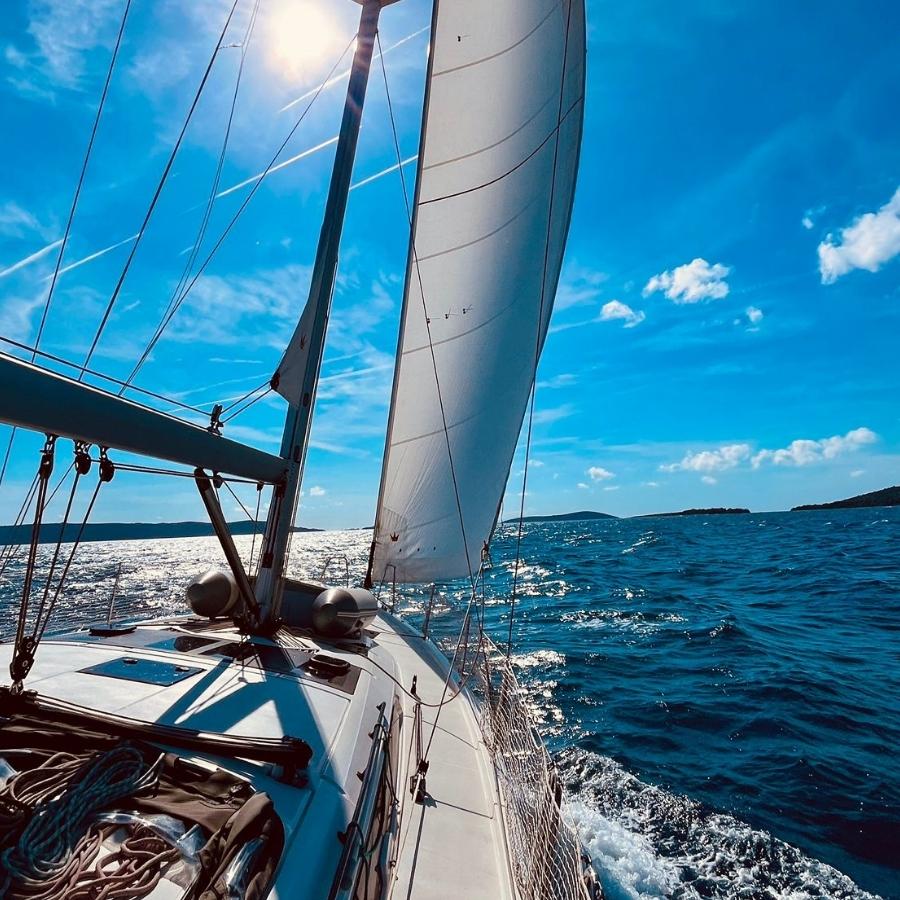
Understanding the wind's strength and direction allows you to control your yacht's behavior on the waves. Source: kochazagle.pl
How do you know which direction the wind is blowing from?
This is one of the first questions asked by yachting license candidates, but also one of the main questions asked during pre-charter check-in. A basic principle of meteorology and nautics is clear: wind direction determines where a gust is coming from, not where it's moving. If you hear the phrase " west wind ," it means the air is coming from the west and moving east.
Many people intuitively wonder which direction the wind is blowing , looking at escaping clouds or waves. However, for a skipper, the point of impact with the yacht is crucial. From those just starting their sailing journey, we often hear " How to determine wind direction" – that is, how to recognize the wind on open water without looking at electronic screens?
How can you determine wind directions and names directly from the deck? Simple indicators are available:
- Observing the water: small ripples and wave crests (so-called gusts) are arranged perpendicular to the wind line.
- Mechanical indicators: ichthyanders, ribbons on the shrouds (side rails) and windex mounted at the very top of the mast.
- Skipper's senses: although it sounds like some kind of prophecy, this oldest method involves slowly turning your head towards the breeze – the moment the buzzing in your ears becomes identical on both sides, you are looking straight into the eyes of the wind.
How to read wind indications in weather forecasts?
Modern weather apps and official navigation announcements use concise symbols. To correctly read wind symbols , you must be able to effectively combine directional arrows with numerical data.
The arrow in graphic forecasts shows the direction of air mass movement – its tip indicates the direction of the wind . If the arrow points to the right, the wind is from the west. Additionally, feathers are placed on the tail of the arrow. Each long feather typically represents 10 knots (kt), while a short feather represents 5 knots. A triangular pennant represents a powerful 50-knot force.
For Polish sailors traveling the world, it's also important whether the forecast provides speed in knots, meters per second (m/s), or the Beaufort scale. Quickly understanding these units protects against unknowingly getting caught in a storm.
Apart from this technical aspect and the designations of winds, an equally interesting topic are the names of winds around the world , the most famous of which we will present later in the text.
The most popular wind names found around the world
The world map of waters abounds with fascinating local meteorological phenomena. Very often, specific types of winds have their own historical names, which have become a permanent part of the dictionaries of skippers leading international voyages. These wind names electrify anyone who has ever experienced their power firsthand.
The Mediterranean basin – extremely popular with Polish crews – is dominated by three wind systems. The first is the Bora – a dry, icy katabatic wind descending from the mountains to the warm waters of the Adriatic in Croatia. It can strike without warning with hurricane force. The opposite is the Sirocco ( Jug ), a warm, humid southerly wind blowing from the Sahara, bringing characteristic red dust and high waves.
Meanwhile, the Aegean Sea in Greece experiences the Meltemi from May to October —a strong, dry northerly wind that provides excellent sailing but requires skillful maneuvering in port. Knowing these anomalies can determine whether your vacation will be idyllic or a struggle for survival.
Incidentally, the historical origins and origins of these particular wind names are also quite interesting . However, this is a topic for a separate article devoted solely to this topic.
Click on the link and check out the offer for yacht charter in Greece

Aerial view of the beautiful Lalaria Beach on Skiathos Island, in the western Aegean Sea. Source: iStock license
Which types of winds are most important when sailing?
In practical terms, sailing wind types are divided primarily by their stability and predictability. Steady winds and stable thermal breezes are crucial for safe and smooth sailing.
A breeze (sea and land) is the perfect friend for a holiday sailor. It's created by the temperature difference between land and water. During the day, the warm land lifts air, drawing in cooler air from the sea – this creates a sea breeze, providing excellent conditions for afternoon sailing.
The situation is completely different when downdraft (katabatic) winds or those caused by the passage of a weather front appear in the water. These winds generate sudden, dangerous squalls, i.e., sudden increases in wind speed combined with a change in direction. These phenomena require immediate reefing (reducing the surface area) of sailing canvas.
Yacht charter and wind conditions – what to check before setting off?
Planning a successful sailing holiday requires a clash between theory and reality. Before deciding on a specific date and region, you should analyze the wind statistics for the given water area. A safe, family yacht charter in areas like the Cyclades in July may prove too demanding due to the aforementioned Meltemi winds. For newcomers, the sheltered waters near the Dalmatian coast or the Spanish Balearic Islands, where conditions are milder, are a much better choice.
Before leaving their marina berth, every skipper has a legal and moral obligation to check the current weather forecast for the next 24 and 48 hours. Key parameters include not only the average gust speed but also, and above all, the maximum strength of storm squalls and the direction from which they will arrive. If the forecast predicts strong easterly winds in a water area where the nearest port of entry is open to the east, the marina entrance can become a death trap. A well-planned route always includes emergency options and shelter on the leeward side of the islands.
True and apparent wind – why do sailors distinguish between the two concepts?
When sailing a yacht, we enter the fascinating world of aerodynamic physics. Every sailor must master a crucial distinction: apparent wind and true wind . Understanding the difference between them is the secret to optimal sail trimming.
- True Wind: This is the movement of air masses measured relative to a fixed point on land or water. It's the wind you feel when standing still on the shore of a marina.
- Self-wind: This is created by the motion of the yacht itself. It has the same speed as the boat, but blows from exactly the opposite direction (generated by the momentum of the hull).
- Apparent Wind: This is the resultant of the true wind and the actual wind. Wind directions and names measured by instruments on a moving yacht always indicate the apparent wind.
It's the apparent wind that our sails react to, and it's this that we adjust their angle of attack to. When sailing hard into the wind, the apparent wind becomes stronger than the actual wind, intensifying the feeling of speed and heel. Sailing with the wind (on full courses), the yacht "escapes" gusts, causing the apparent wind to weaken, and a seeming calm prevails on deck, even though the waves astern can be powerful. Different types of wind have a huge impact on the comfort of our sailing, so it's definitely worth cooperating with nature.
How does the yacht's course relative to the wind affect the handling of the vessel?
The angle at which the hull intersects the wind determines the dynamics of the entire voyage. This relationship determines the yacht's course relative to the wind . There are several basic courses, each posing different technical challenges for the crew.
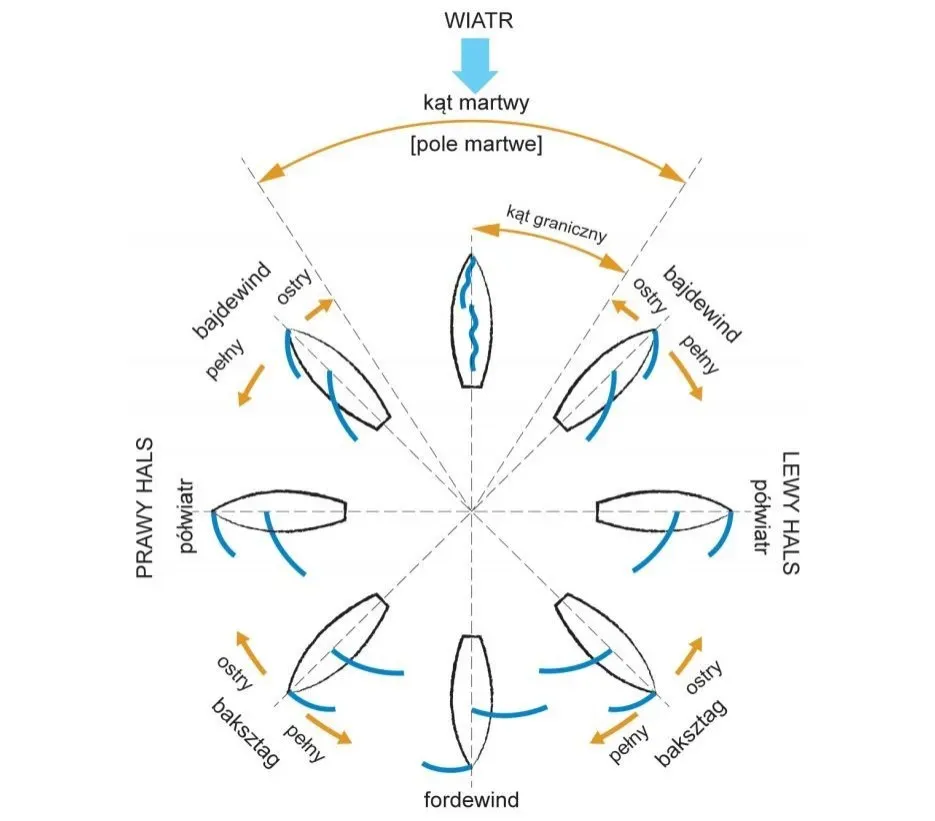
Wind angles determine how the sails work and are trimmed. Source: Szekla Sailing School
How a yacht's course relative to the wind affects its handling is most evident in strong gusts. In a baywind, a strong westerly wind will cause a significant heel and force the crew to ballasting. In a forewind, there's almost no heel, but there's a risk that an unexpected wave will change the stern's position and trigger a sudden, dangerous gybe. Here's what it looks like in practice:
|
Course relative to the wind |
Characteristics and angle |
Sail operation and yacht behavior |
|
Dead angle |
the yacht sails straight into the wind (zone approx. 45°). |
The sails flap loosely (they flutter like flags). The boat loses power and comes to a quick stop. |
|
Bajdewind |
Close course (approx. 45° - 60° from the wind axis). |
Sails are heavily trimmed (pulled close to the axis of symmetry). Hull heel is significant, allowing for dynamic sailing against the waves. |
|
Half-wind |
The wind blows perfectly alongside the yacht (90°). |
Sails loosened about halfway. The most stable, safest, and fastest cruising course. |
|
Backstay |
The wind blows diagonally from behind (approx. 100° - 160°). |
The sails are very loose. The yacht sails very smoothly, easily planing in waves. |
|
Fordewind |
The wind blows perfectly towards the stern of the vessel (180°). |
Sails fully open (often in a butterfly configuration – jib on one side, mainsail on the other). |
Understanding this table makes maneuvering easier. Remember that a sudden, gusty westerly wind on a bayside course will cause an immediate, deep heel, requiring a quick easing of the sails (called a luff). On a foreside course, the same gust won't cause heel, but it carries the risk of an uncontrolled, dangerous gybe, which can damage the rigging.
How to use knowledge about the wind when planning a cruise?
An experienced skipper doesn't fight the elements; instead, they gain an advantage by cooperating with them. Knowing the names of winds in sailing and how they are generated allows you to plan your route so that most of the way is covered comfortably on a broad reach or beam reach.
If you know that a cool onshore wind prevails in a given area at night, you can take advantage of this to leave port in the morning. Planning long passages into a strong, prevailing southerly wind will force you to engage in arduous tacking (zigzagging), which will triple the length of the journey and tire the crew. Good navigation is navigating in harmony with the synoptic chart and nature itself.
FAQ: Everything you need to know about winds in sailing
What wind indications appear most often in sailing forecasts?
In professional forecasts, the most common cardinal directions are N (north), S (south), E (east), W (west), and combinations thereof (e.g., NW, SE). Wind speed is typically reported in knots (kn or kt), meters per second (m/s), or degrees Beaufort (°B).
Is the WNW wind direction favorable for sailing?
It depends entirely on the course you want to sail. A wind direction of WNW means the wind is blowing from the west-northwest sector. If your destination is to the east, you'll sail a comfortable downwind course (a running or forewind). However, if you have to sail due northwest, you'll face challenging sailing with a strong backwind.
In which direction does the wind designated as easterly blow?
An easterly wind blows from the east towards the west. In nautical and meteorological terminology, the name of the wind always identifies its point of origin (where the gust is blowing from), allowing for easy determination of windward and leeward positions.
What names of winds in sailing are worth knowing before your first sail?
Before setting sail, especially in the Mediterranean, it's worth familiarizing yourself with terms like Bora (a strong, cold downdraft wind), Sirocco/Jug (a warm southerly wind bringing waves), and Meltemi (a steady, strong northerly wind in Greece). On inland waters, the key term is simply a squall—a sudden, gusty gust of wind.
Do westerly and easterly winds affect the handling of a yacht in the same way?
The mechanics of how the sails operate are identical, but their impact depends on the shape of the water's coastline. On the Polish Baltic coast, westerly and northwestern winds create very large, dangerous waves that crash against the shore, making port access difficult. On the other hand, easterly winds blow partially from land, causing the waves to be much smaller near the shore.
How to determine wind direction while sailing without specialized equipment?
The best natural indicator is to observe the water surface—small ripples form perpendicular to the direction of the breeze. You can also observe flags, smoke from chimneys on shore, or the movement of other anchored yachts, which naturally position themselves with their bows into the wind. Another simple method is to turn your head to hear the even sound of the wind in both ears.
Does the yacht's course relative to the wind affect the sailing speed?
Yes, and it's huge. Sailing yachts rarely reach their maximum speed sailing perfectly downwind, because the sails then act as simple drag brakes. The highest speeds are achieved on broad reach and beam reach courses, where the sail acts like an airplane wing, generating a powerful aerodynamic force.
What types of winds are most common in sailing waters?
Most tourist waters are dominated by breeze-like winds (resulting from the temperature difference between land and water) and gradient winds associated with the passage of low- and high-pressure systems. In sheltered waters, such as lakes, local winds are key, modified by the proximity of forests or hills.
Set off on a sailing adventure!
Theory is one thing, but a true feel for the wind is gained on deck, with the rudder and lines in your hands. Nothing beats the satisfaction of intuitively reading the clouds and perfectly positioning the yacht on the wave after a whole week on the water.
Planning your next cruise? Don't let good conditions slip away. Choose a modern, safe catamaran or agile monohull, perfectly suited to your favorite waters. Check availability and book your yacht charter with Travelboat now – the names of the winds are waiting for your skills!