Skip to content

Yacht Storming – A Practical Guide for Sailors
Author: Travelboat team
Every skipper, regardless of experience, must be prepared for sudden changes in weather. In this guide, you'll learn how to properly storm a yacht, how to efficiently operate equipment, and how to care for the crew when conditions become extreme. With tips from Travelboat experts, you'll safely reach any destination.
Yacht Storming – A Practical Guide for Sailors
Sailing isn't just about tacking from bay to bay in a pleasant breeze of 3-4 on the Beaufort scale. Above all, it's about managing crisis situations. Imagine this: the sky on the horizon takes on a leaden hue, the barometer plummets, and the wind begins to whistle ominously through the shrouds. That's when the real test of seamanship begins.
A properly planned stormy yacht is the difference between an exciting maritime adventure and a dramatic fight for survival. In this article, we'll break down all the safety procedures, maneuvers, and equipment preparation that will allow you to emerge unscathed from any storm.
Storm description – how do sea conditions change?
Before we get to the maneuvers themselves, let's take a look at what a storm is from a meteorological and practical perspective. According to the official definition and the international Beaufort scale, a storm is defined as a wind force of at least 8 (wind speeds of 34 to 40 knots). However, for the crew of a sailing or motor yacht, the description of a storm primarily refers to a dynamic change in sea state.
In the first phase, the wind breaks off the wave tops, creating characteristic white crests (so-called "lambs"). As the wind strength increases, the swell develops. The waves become high, steep, and develop crests that begin to break. Dangerous waves form, and wind foam reduces visibility to several dozen meters.
The situation changes incredibly rapidly. A few dozen minutes is all it takes for a calm sea to turn into a roaring swell. Polish sailors sailing the Baltic or North Sea know all too well that a short, steep swell here can be much more dangerous and damaging to a hull than a long ocean swell in the Atlantic. A detailed description of a storm also includes a sudden drop in temperature, heavy drizzling rain, and intense noise that significantly impedes communication on board.
Storm at Sea – When Do Conditions Become Dangerous?
Sailing in challenging conditions requires constant monitoring of the environment. A storm at sea becomes a direct threat when wave heights exceed the comfort and safety limits of a vessel's design, and the crew begins to experience severe fatigue or seasickness.
Factors that increase risk:
- Proximity to a windward shore: a sailor's greatest enemy during a storm is not the open sea, but the shallows and land onto which the wind can push an uncontrolled vessel.
- Breaking Waves: Breaking wave crests striking the side of a yacht at a right angle can cause the vessel to capsize (capsize overboard) or wash sailors off the deck.
- Sudden pressure surge and wind change: Sudden changes in wind direction accompanying the passage of atmospheric fronts create what's known as a cross-sea. Waves arriving from two different directions overlap, creating unpredictable water pyramids.
When a storm at sea develops to a point where traditional navigation to the destination port is no longer possible or safe, the skipper must make the decision to switch to defensive mode.
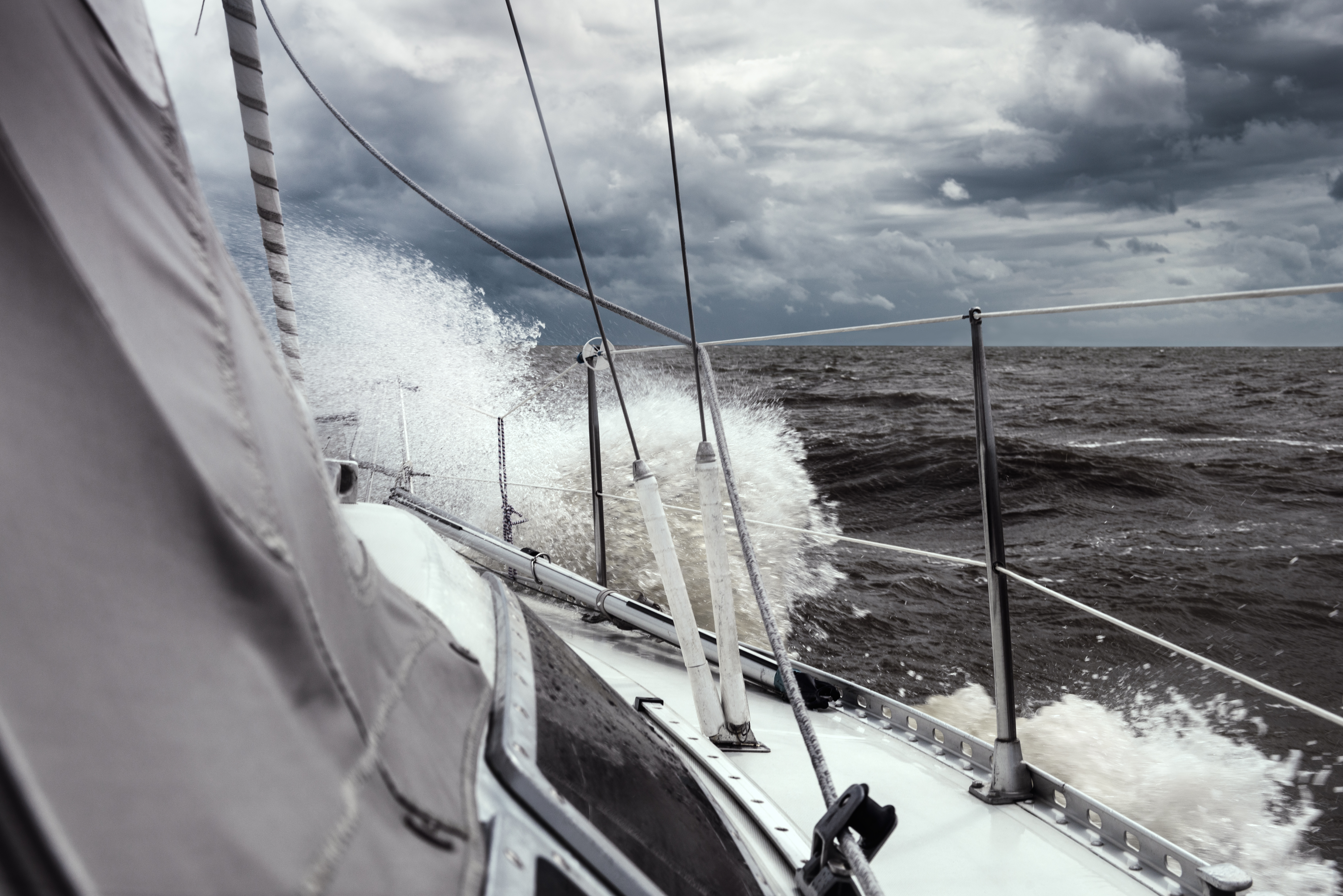
A sailboat in a storm. Source: iStock license
Preparing the yacht and crew before the storm arrives
The best way to deal with storms is to prepare well in advance. When weather forecasts (GRIB, NAVTEX, VHF messages) indicate a break in the weather, it's essential to implement storm-prep procedures. To avoid being caught off guard by the dynamic changes in the sky, check out our guide: weather for sailors and learn what tools to use before leaving port.
1. Interior and deck protection (Storm Clearance)
Anything that is not permanently attached will become a dangerous projectile during a storm.
- Below deck: Secure the galley by stowing pots and pans, closing gas and seacocks, except for the cockpit drain and engine cooling. Lock cabinets and hatches.
- On deck: pull the lifelines (Laufline) from bow to stern. Secure the bow anchor with an additional stay. Coil and secure the sheet lines securely, and check the dinghy and lifebuoy attachments.
2. Crew preparation
As the wind increases, the sudden “storm of what to do” becomes a question that every crew member must know the answer to without hesitation.
- Clothing: Everyone wears oilskins, thermal underwear and appropriate footwear.
- Personal protective equipment: everyone, without exception, puts on pneumatic vests and clips themselves into the safety straps before leaving the mess hall to the cockpit.
- Food and hydration: Prepare thermoses with hot tea/coffee and light, high-energy snacks. During a storm, cooking below deck will be impossible and extremely dangerous.
- Watchkeeping: implement a shortened watch system (e.g. 2 hours) to avoid hypothermia and extreme fatigue of helmsmen.
Yacht Storming – The Most Important Techniques and Safety Rules
When the waves are high and the wind prevents normal sailing, it's time to implement specific technical procedures. Storming a yacht involves maintaining control of the vessel and minimizing the forces acting on the hull and rigging. The method chosen depends on the yacht's design, wind strength, sea state, and available water space (also known as headroom).
Driving a yacht into the wind (hard storm)
This is a traditional method of sailing with very reduced sails (e.g. just a storm jib or a mainsail reefed to the third reef) as close to the wind as possible.
- Advantages: the yacht constantly passes through the waves with its bow, which is most resistant to the impact of the water mass.
- Disadvantages: huge loads on the rigging, constant slamming of the hull against the water (so-called slamming), high crew fatigue and strong drift.
Setting the yacht into a drift (drifting/almost drifting)
One of the most popular and safest techniques for cruising yachts, it involves setting the sails in opposition (the jib to windward, the mainsail catching the wind from leeward, and the rudder to windward).
- The yacht is positioned at an angle of approximately 45–60° to the wind and slowly moves sideways, creating a slick (an area of swirling water) on its windward side that effectively extinguishes the breaking wave crests.
- This is the perfect time for the crew to rest, gather their thoughts, or make minor repairs.
Escaping with the wind (storming with the wind)
It involves riding a wave in a leeward direction just under the hull or with a minimal sail area at the bow (e.g. storm jib).
- Key element: maintaining the right speed is crucial. If the yacht is going too fast, it can slide off the wave, ram the bow into the preceding wave, and capsize over the bow (pitchpole). If it's going too slowly, a breaking wave from the stern can flood the cockpit or cause the yacht to spin across the wave (broaching).
- To control speed when running downwind, a tow rope looped over the stern or a specialized drift anchor is ideal.
Sea anchor – application and method of use during a storm
Many sailors ask: how to use a sea anchor to fully utilize its potential? A sea anchor (sea anchor or drogue) is a flexible cone of strong material that acts like an underwater parachute. It creates resistance in the water and stabilizes the vessel's course.
Types and differences:
- Sea Anchor: A large canopy placed from the bow. Its purpose is to keep the bow of the yacht pointed into the waves and wind, almost completely stopping the yacht's progress.
- Drogue (e.g., Jordan Series Drogue): A smaller canopy or series of small cones pulled astern. Its purpose is to slow the boat downwind and prevent the stern from rolling dangerously across waves.
|
Characteristic |
Sea Anchor |
Drogue |
|
Place of attachment |
Beak |
Stern |
|
Main goal |
Keeping the bow to the wind/waves |
Slowing down the escape with the wind |
|
Speed reduction |
Almost to zero |
Controlled speed (2-4 knots) |
|
Space required |
Lots of water to the lee |
Lots of space downwind |
Float anchor – how to use it in practice?
- Rope length: The sea anchor rope must be sufficiently long (at least 5-10 times the length of the yacht) and flexible (preferably nylon). It is important that the yacht and the sea anchor are at the same time at the crest or trough of the wave.
- Abrasion protection: A rope subjected to extreme stress can wear out very quickly on the bow cleat or hawse pipe. Leather or rubber protectors should be used at these friction points.
- Hauling: Always use a rescue line (also known as a canopy rope) to easily fold the sea anchor and retrieve it on board after the storm has passed.
Yacht charter – choosing the right vessel for demanding conditions
There's no safer sailing experience than on a well-functioning, well-designed, and properly selected vessel. When planning a cruise in waters known for their fickle weather (e.g., the Baltic Sea, the North Sea, or even the windy Cyclades in Greece during the Meltemi), a carefully considered yacht charter is crucial. Each hull type reacts differently when a storm breaks out at sea.
For those who appreciate stability and immense space, a catamaran charter is an excellent choice. Twin hulls provide unparalleled comfort and minimize heeling in waves, although during extreme storms they require the skipper to be vigilant and reef early. Traditional sailing yacht charters, on the other hand, with their deep keels and heavy ballast, guarantee incredible straightness – a monohull yacht is very forgiving of mistakes in waves and can recover even after the mast is deeply crushed in the water.
If you prefer dynamics and independence from the wind, check out motor yacht charters. When choosing a motorboat for the open sea, make sure it has a high design class (Category A or B) and a fuel reserve for extended periods of rough seas at low speeds. On the Travelboat platform, you can easily filter offers by safety equipment and sailing class.
Yacht boarding as one of the methods of saving the vessel
In extreme emergency situations, when the hull is leaking, the rudder fails, there is a fire, or when storming in deep seas is no longer possible and the yacht is drifting helplessly onto a rocky shore, the final remedial maneuver is to beach the yacht.
Yacht beaching is the deliberate and controlled movement of a vessel onto a shallow water, sandy beach or soft bottom in order to save the lives of the crew and avoid sinking in deep water or smashing into rocks.
How to perform controlled stranding?
- Choosing a spot: Check the map for flat, sandy, or muddy beaches that are sheltered from direct waves. Avoid shores strewn with boulders and rocks.
- Approach angle: The beach should be approached perpendicular to the shoreline and wave, maintaining minimum steering speed.
- Seat belts and preparation: Crew must be on deck wearing life jackets, protected against sudden stops.
- Throwing out the stern anchor: shortly before hitting the bottom, it is worth throwing out the stern anchor – it will help keep the yacht perpendicular to the shore and make it easier to pull it out of the shallows later with a tugboat.
It should be remembered that beaching a yacht is an absolute last resort, but in the face of an imminent maritime disaster it can save what is most important – human life.
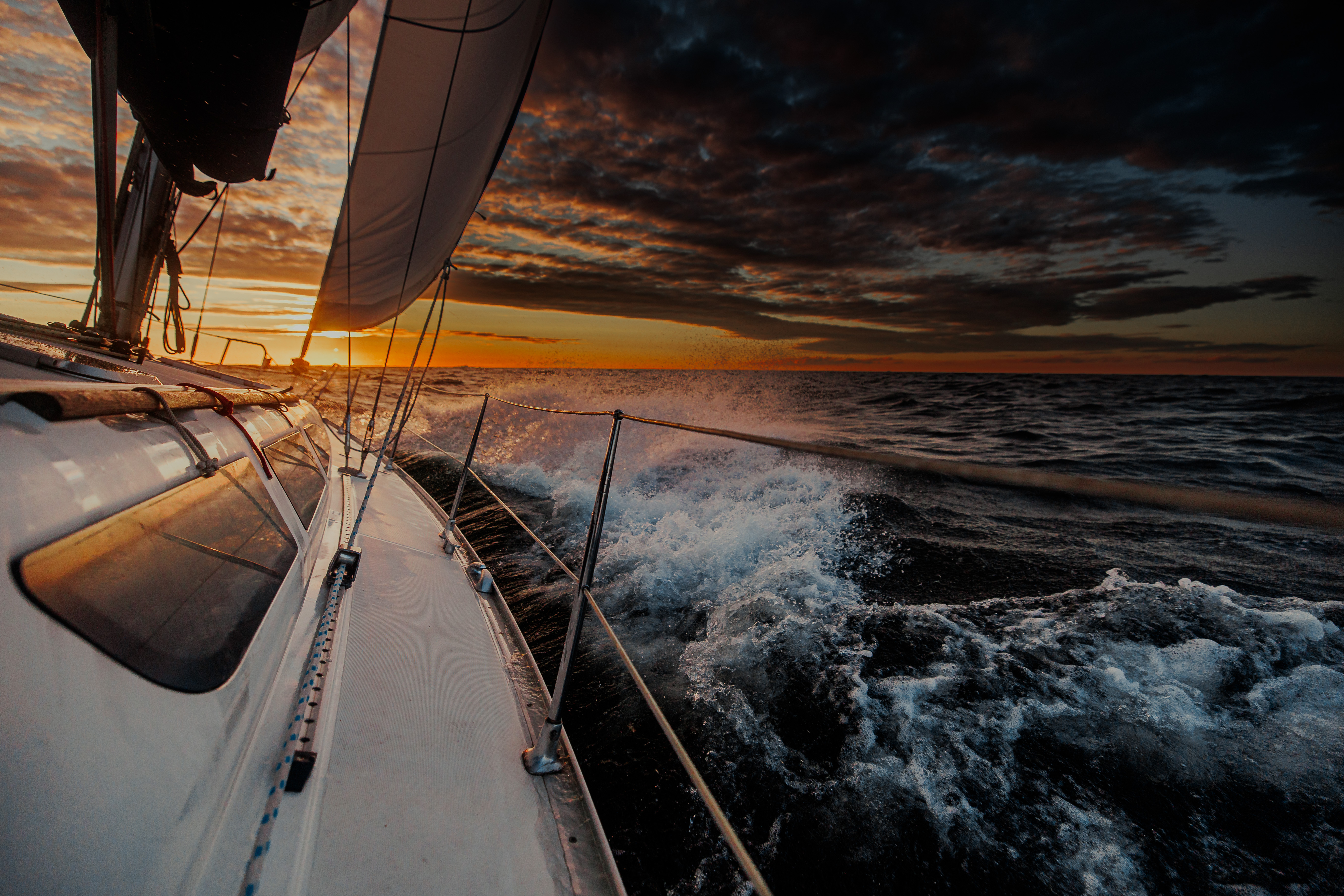
Sailing in high tide. Source: iStock license
Ships in a storm – how do large vessels cope?
Observing massive container ships or bulk carriers from the deck of a small yacht during a storm can be awe-inspiring. Ships in a storm operate on a completely different scale of physics, even though their captains face similar challenges related to material stresses.
Large ships also struggle during storms with slamming (the flat bottom of the bow striking the water) and sagging and hogging of the hull (sagging and hogging). A large ocean liner or bulk carrier can bend in waves by over a meter! To safely survive these challenging conditions, ships reduce engine speed (reducing the load on the propeller and shaft) and ride the storm with the wind and waves pressing down on the bow at an angle of approximately 20-30 degrees.
From the perspective of a small recreational yacht, it's crucial to remember one thing: ships have drastically reduced visibility from the bridge during storms, and their stopping distance is often several nautical miles. On a stormy night, a large commercial vessel might miss your yacht on radar due to the wave clutter. Using an AIS transponder and radar reflector on your yacht is absolutely essential.
Storm procedures – what to do to increase safety?
Let's summarize the key algorithm. Effective storm management relies on iron discipline, maintaining composure, and role allocation. Here's a condensed checklist worth implementing:
Mandatory steps in a storm:
- Storm: What to do first? Turn the bilge pumps on automatically and check regularly for water accumulation in the bilge.
- Monitor your position on the map: Record your geographical position in your yacht's logbook (traditionally, on paper) every 30-60 minutes. In the event of an electronics failure, you'll know where you are.
- Monitor the crew's condition: watch for signs of hypothermia and dehydration. A sailor weakened by seasickness quickly loses the ability to make rational decisions.
- Take care of your rigging: regularly check the sheets and halyards for abrasions where they come into contact with the blocks and rollers.
- Maintain constant communication: keep your VHF radio on channel 16. In the event of an immediate threat to life, do not hesitate to use the MAYDAY or PAN PAN signal.
The most common mistakes made during storms
Even an optimized yacht and a good weather forecast won't help if the skipper succumbs to routine or panic. Here's a list of the most common mistakes you should avoid at sea:
- Reefing the sails too late: this is a cardinal sin for beginner sailors. You should reduce the sails when you first think, "Maybe it's worth it," not when the boat is sailing at a constant 45-degree list and the rudder becomes unresponsive.
- Panic and abandoning the yacht too early: Sailing history is replete with dozens of cases where a crew panicked and evacuated to a life raft, only to find the abandoned, drifting yacht safe and sound after a storm. A life raft is the absolute last resort—we only resort to it when the yacht is truly sinking.
- Lack of personal protection: failing to clip into the decking tape "just for a moment" to adjust the boom's vang often results in a fall overboard (MOB). Finding a person in a storm's surf is nearly impossible.
- Ignoring the windward shore: Waiting too long to move away from shore into open water. Battling a storm in shallow water almost always ends in tragedy.
Safely surviving a wave in open water is one thing, but returning to a crowded port in gusty winds requires a whole new level of precision. Read the article "Port Maneuvers Step by Step - A Guide for Sailors" to master docking in difficult wind conditions without stress or hull damage.
FAQ: Frequently Asked Questions
What conditions must be met to speak of a storm?
To be considered a storm, meteorologically speaking, winds must reach at least force 8 on the Beaufort scale (approximately 34-40 knots or 62-74 km/h). It is accompanied by severely rough seas, high waves with breaking crests, and a sharp drop in pressure.
When is it advisable to use a sea anchor when sailing a yacht in a storm?
It is worth using a drift anchor when the force of the wind and waves prevents the yacht from being sailed in the traditional way, there is enough free space in the water to handle the wind (distance from land), and the skipper wants to stabilize the vessel, reduce the drift speed and give the tired crew time to rest.
Does beaching a yacht always indicate an emergency?
Yes. Beaching a yacht is a last resort maneuver, performed in situations where the crew's life is in immediate danger or the vessel is imminently destroyed on the rocks. It involves deliberately grounding the yacht onto a sandy bottom or beach.
How do ships behave during a storm on the open sea?
Large commercial vessels reduce speed to reduce hull stress and maintain a course at a slight angle to the waves. Despite their enormous size, they are subject to enormous g-forces and hull bending, and their visibility and ability to maneuver quickly are severely limited.
Is every yacht suitable for sailing in a storm?
No. Vessels meeting Design Class A (Ocean) or B (Offshore) standards are suitable for safe navigation in stormy conditions. Inland yachts and small coastal vessels (Categories C and D) are not designed to withstand stormy waves.
What equipment increases safety during a storm?
Basic storm equipment includes: safety belts and straps (Laufline), pneumatic life jackets with moustaches and lighting, sea anchor, storm sails (storm jib, trysail), a working bilge pump, a VHF radio with DSC, AIS, pyrotechnics and a life raft with a valid certificate.
Should the condition of the yacht be checked after a storm?
Absolutely. Once the challenging conditions have passed, a thorough inspection of the bilge (checking for leaks), standing and running rigging, engine mounts, positioners, and the condition of the electrical panels and batteries should be carried out.
Secure your cruise with Travelboat!
Sailing is a wonderful passion that offers an unlimited sense of freedom, provided you treat the elements with due respect and proper preparation. A good skipper isn't the one who has weathered the most storms, but the one who can avoid them or face them with top-of-the-line equipment.
Planning your next cruise on the Baltic, Mediterranean, or Caribbean? Don't risk it by half-measures. Choose tested, safe, and well-equipped vessels from certified fleets.